
Small Space Bedroom Furniture That Fits Real Rooms
Small space bedroom furniture should be chosen by movement first and appearance second. A bed can look perfect in a product photo and still make the room difficult if drawers cannot open, doors cannot swing, or the nightstand becomes a traffic cone.
The best compact bedrooms do not rely on tiny furniture everywhere. They use a few correctly scaled pieces, then give each one a job that matches the daily routine: sleeping, dressing, laundry, charging, and resetting.
Before buying another piece, decide what problem the room is actually asking you to solve. A larger dresser may be wrong if the true problem is one narrow bedside landing place or a wardrobe that blocks the first step from the door.
Small Space Bedroom Furniture Starts With Clearance
Small space bedroom furniture begins with clearance because furniture is only useful when bodies can move around it. Measure the bed, dresser, wardrobe, and door behavior as active objects, not as flat shapes on a floor plan.
Leave room for the ordinary motions that happen when you are tired: stepping out of bed, pulling a drawer, turning with laundry, and reaching a lamp without knocking over a glass.
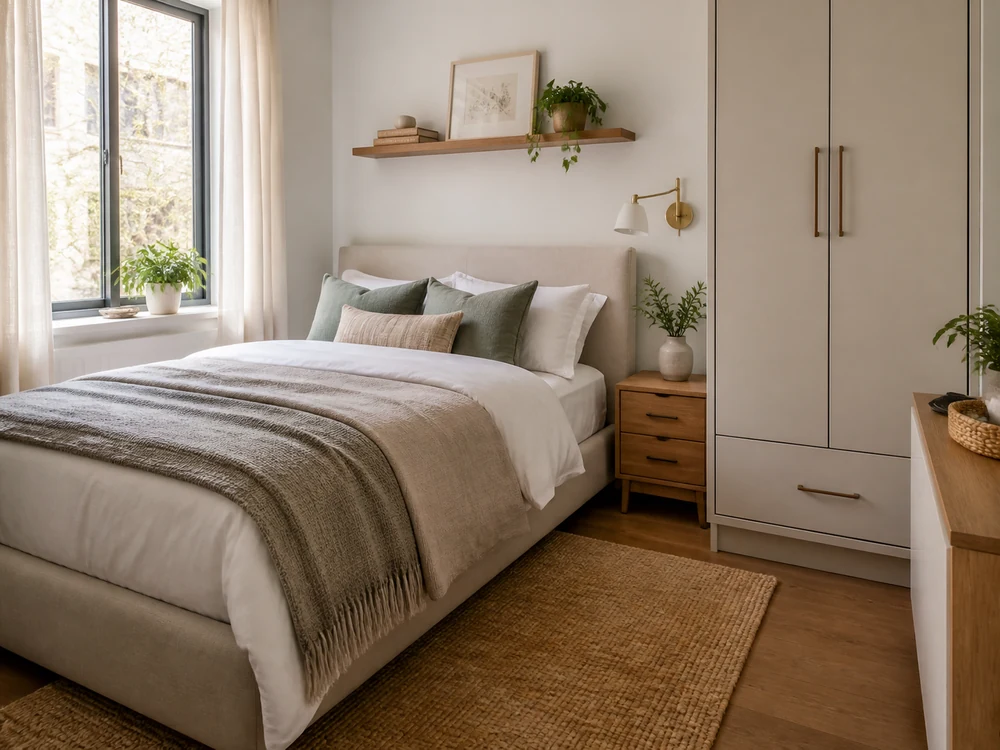
Choose The Bed By What Happens Around It
The bed is not just a mattress platform. It creates the walking lane, decides whether two people can move, and controls how much furniture can sit near the walls.
A low storage bed may help a room with poor closet space, but it only works if the drawers can open fully. In a very narrow room, lift-up storage or a simple frame with bins may be calmer than side drawers.
Let One Nightstand Be Enough
Two matching nightstands can make a small bedroom feel staged rather than useful. One real nightstand and one lighter ledge, stool, or wall pocket may protect the room’s balance.
Give the full nightstand to the side that holds more routine objects. The lighter side can still carry a sconce, phone, or book without demanding the same footprint.
Use Dressers Where Folding Actually Happens
A dresser should sit close to the place where clothes are returned. If folded laundry has to cross the room, the bed will become a sorting table for longer than you planned.
Taller dressers often beat wider ones in compact bedrooms, but only when drawers are easy to reach. A top drawer above shoulder height will become storage for things you avoid.
Pick Wardrobes By Door Type
Wardrobe depth matters, but door type matters just as much. Hinged doors need open space, sliding doors need clean tracks, and curtain-front storage needs discipline behind the fabric.
If the wardrobe faces the bed, test the space with hangers in hand. A wardrobe that requires a side step every morning will feel larger than its dimensions.
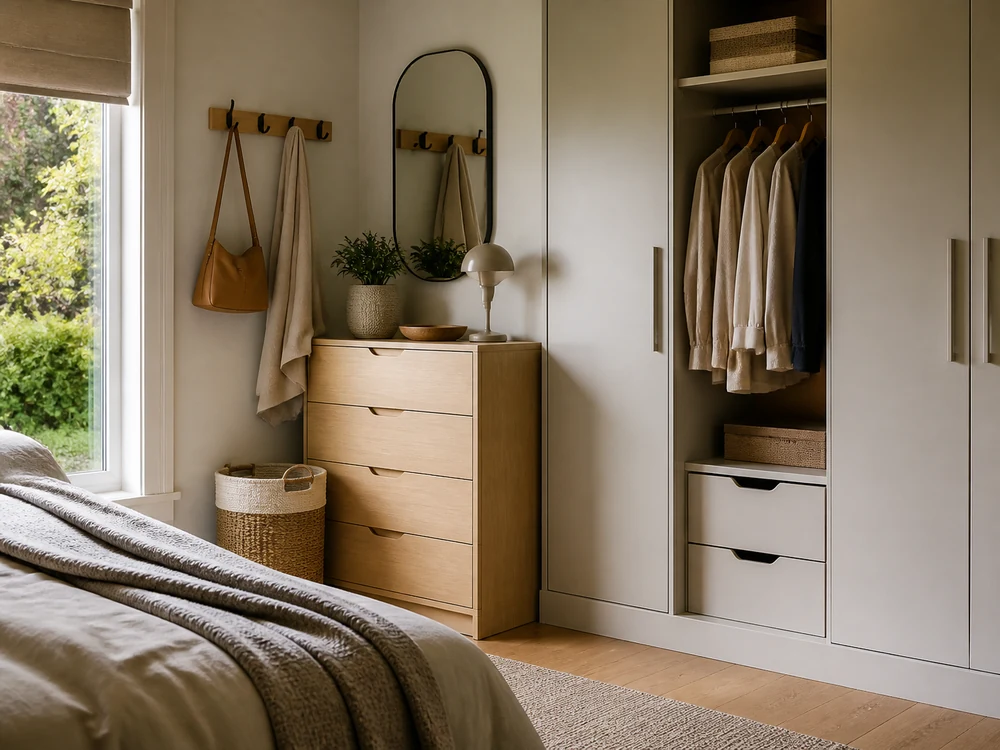
Anchor Tall Pieces Before Styling Them
Tall furniture in a small bedroom should be treated as structural, not decorative. A slim bookcase, wardrobe, or chest can add serious storage, but it needs stable placement and correct anchoring.
Review the manufacturer’s hardware and the CPSC Anchor It furniture safety guidance before loading tall bedroom furniture. Safety is part of the layout, not a detail to handle after styling.
Make The Mirror Work For Dressing
A mirror earns its place when it supports dressing and borrows light. It should not reflect a messy chair, open hamper, or crowded shelf that doubles the visual noise.
A tall narrow mirror can do more for a compact bedroom than a wide decorative mirror. It uses less wall, helps the morning routine, and can make the route feel longer.
Give Laundry A Furniture-Level Decision
Laundry is not an accessory in a small bedroom. It needs a furniture-level decision because dirty clothes, clean clothes, and half-worn clothes create three separate flows.
Use a hamper that sits where clothes actually drop. If you need a chair for half-worn items, choose a small valet hook or wall peg instead of surrendering the only seat.
Use Shelves Above Work Zones, Not Sleep Zones
Shelves are useful in small bedrooms when they sit above a dresser, desk, or door-adjacent wall. Over the pillow, they can feel heavy and make sleep space feel less restful.
Keep shelf depth shallow and categories simple. A shelf holding books, a plant, and one box feels intentional; a shelf of mixed daily items feels like a postponed drawer.
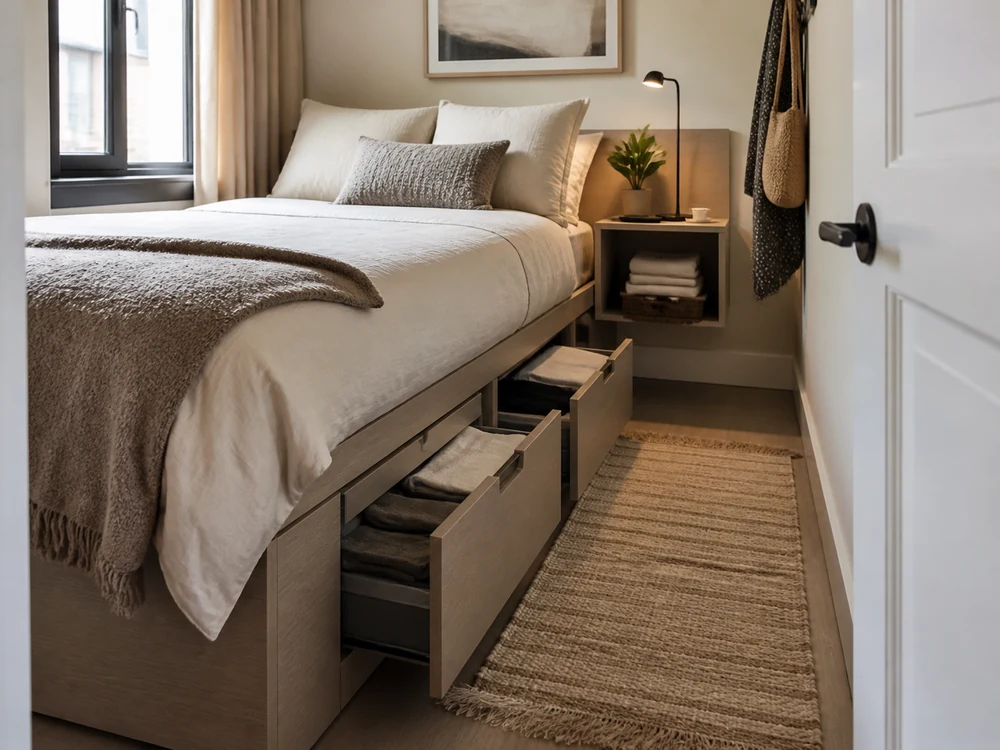
Let Lighting Replace Extra Tables
A wall sconce or clip lamp can remove the need for a second nightstand. In a small bedroom, lighting is often the quietest way to gain function without adding another surface.
Efficient lamps also reduce heat and energy waste. The Energy Saver lighting guidance offers a practical reference when choosing bulbs for rooms that need long evening light.
Keep Under-Bed Storage Honest
Under-bed storage should hold slow categories: off-season clothes, spare linens, or guest blankets. It should not hold daily items that require kneeling every morning.
Choose containers that slide out cleanly and leave enough room for vacuuming. A hidden storage area that cannot be cleaned becomes a dust trap, not a solution.
Use Rounded Edges Where Routes Are Tight
When the route beside the bed is narrow, rounded furniture edges matter. A round stool, curved nightstand, or soft ottoman can make the room kinder to move through.
This is not only visual softness. It is the difference between brushing past a piece and bumping into it every time you carry laundry.
Choose Multi-Use Pieces With One Main Job
Multi-use furniture fails when it tries to solve every problem. A storage bench should primarily hold linens, shoes, or bags, not all three at once.
Give each piece one main job and one secondary job at most. That boundary keeps furniture from becoming a mystery box with better upholstery.
Protect The First View From The Door
The first view tells the brain whether the bedroom is calm. If the door opens to a crowded dresser top, stuffed wardrobe, or visible laundry, the room feels smaller before you enter.
Place the cleanest surface or softest textile in that view. The room can be compact and still feel composed when the first sightline is edited.
Audit Furniture On A Real Morning
The final test is a normal morning, not a freshly styled room. Watch what you touch, what blocks you, where clothes land, and which surface collects the first small object.
Fix the friction rather than buying another organizer. The best small bedroom furniture plan is the one that makes the first ten minutes of the day easier.
Keep Furniture Legs Visually Light
Visible legs can make furniture feel lighter because the floor continues underneath the piece. This matters in a compact bedroom where every solid block makes the wall feel shorter.
Use this trick selectively. A raised nightstand or dresser can help the room breathe, while a solid storage bed may still be worth it if hidden capacity solves a real closet problem.
Do Not Buy For The Perfect Weekend
Bedroom furniture should serve the weekday version of the room, not the ideal weekend when everything is folded and styled. A piece that only works when the room is spotless is too fragile.
Choose the furniture that supports imperfect routines: one open landing spot, one laundry boundary, one reachable drawer group, and a bed path that works even when the hamper is full.
Decision Guide
| Problem | Better Move | Watch Point |
|---|---|---|
| Drawer cannot open fully | Switch to a taller chest, lift-up bed, or shallower piece | Closed measurements hide friction |
| Nightstands crowd the bed | Use one full table and one wall ledge | Symmetry is not required |
| Closet access feels tight | Change door behavior before adding bins | Access beats capacity |
| Laundry lands on furniture | Add a real drop-zone solution | Half-worn clothes need a home |
Related Her Neat Nest Guides
Final Takeaway
Small space bedroom furniture works when each piece protects a routine. Choose clearance before capacity, give storage one clear job, keep tall pieces secure, and let the room prove itself on a real morning.
FAQ
What furniture is best for a small bedroom?
Choose a correctly scaled bed, one useful bedside surface, a dresser with full drawer clearance, and wardrobe storage that does not block the main route.
Is storage furniture worth it in a small bedroom?
Yes, when the storage supports real routines and can be opened, cleaned, and reset easily. Hidden storage that is hard to reach will not stay useful.
How do I make small bedroom furniture look less crowded?
Use fewer matching pairs, keep one clean first-view surface, choose shallow or rounded pieces near tight routes, and move mixed storage behind doors.