
Musical instruments ask for two opposing things: protection from the room and an invitation to be played. A guitar buried behind luggage is safe from passing elbows but absent from daily life; a violin displayed beside a sunny window may look inviting while enduring heat, light, and changing conditions.
An instrument should be stored for the next practice, not merely hidden. Climate, case support, bow or mouthpiece care, and the route to a music stand matter more than squeezing every accessory into one bench. Treat it as the governing rule behind the small apartment musical instrument storage ideas below.
Thoughtful small apartment musical instrument storage ideas hold that tension carefully. Fitted cases, stable floor support, a measured keyboard shelf, and one accessory drawer can keep practice close without turning the living room into a rehearsal studio or placing delicate equipment in the traffic lane.
Begin with the maker's care guidance and the specific materials involved. Wood, skins, reeds, electronics, bows, finishes, adhesives, and strings respond differently to heat, moisture, dust, and pressure. When an instrument is valuable, old, damaged, or unusually sensitive, consult a qualified repair professional before changing its storage routine.
Document the instrument before choosing furniture. Record its serial number, fitted case, current condition, replacement value, and any insurance requirements in a secure location separate from the case. Measure the closed case at its widest hardware, then add hand clearance for every latch and handle. In a shared building, also map quiet practice hours and the path to an elevator or stairwell; a storage position that protects the instrument but makes every lesson a difficult carry will not remain useful for long.
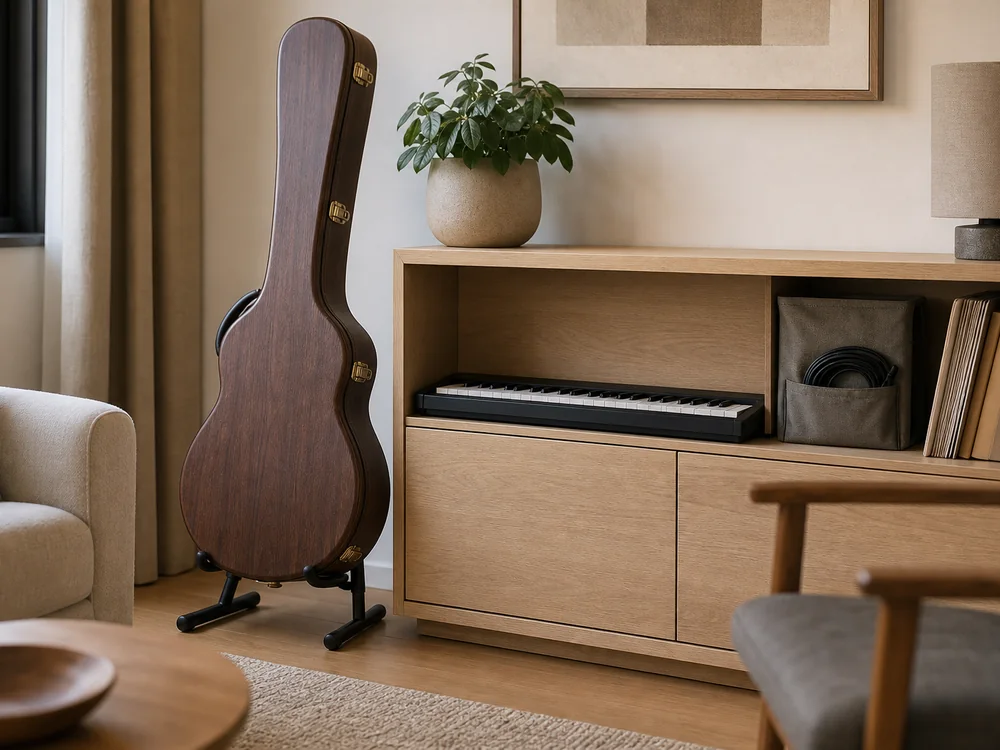
Map Heat, Sun, Moisture, And Traffic First
Walk the room before placing an instrument. Mark radiators, HVAC blasts, direct window light, exterior walls, humid corners, kitchen steam, pet routes, and the path used for groceries or laundry.
The calmest interior location is often better than the most photogenic one. Leave enough clearance to open the case fully and lift the instrument without striking a shelf, lamp, ceiling fan pull, or door handle.
Before finalizing “Map Heat, Sun, Moisture, And Traffic First,” rehearse the least convenient version of the routine: low light, limited time, or a partially occupied work surface. Then check whether “Small Apartment Musical Instrument Storage Ideas Start With Cases” still has a safe route. For musical instrument, resilience in that ordinary moment is more valuable than a perfectly full shelf.
Small Apartment Musical Instrument Storage Ideas Start With Cases
A fitted hard or protective case offers the clearest boundary against knocks, dust, and accidental handling. Close latches correctly, keep the case supported across its intended surfaces, and avoid stacking unrelated boxes on top.
Soft gig bags are convenient for transport but may not provide the same impact or environmental protection. Match the case to the instrument, household, and frequency of use rather than assuming every bag is long-term storage.
The apartment tradeoff behind “Small Apartment Musical Instrument Storage Ideas Start With Cases” appears when it competes with “Support Cases Without Letting Them Lean.” Give priority to the condition that is hardest to reverse, then let convenience decide between the remaining options. For musical instrument, that usually means preventing damage or lost context before trying to save a few more inches.
Support Cases Without Letting Them Lean
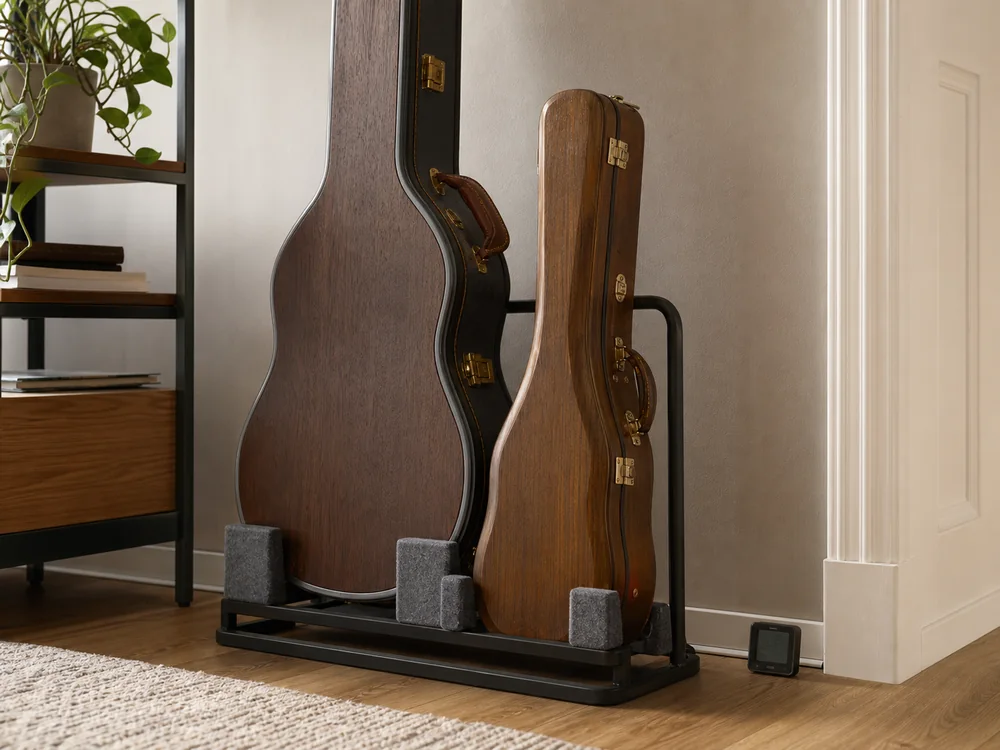
Use a stable floor rack with padded contact points or store cases flat where the manufacturer permits. A case leaning behind a door can slide, receive pressure at one corner, and become an obstacle during the first rushed entrance. Keep heavier cases low and separate shapes with felt so hardware does not scratch neighboring cases.
Check that the rack remains stable when one case is removed and the load becomes uneven. Cases, stands, and accessory drawers make small apartment musical instrument storage ideas work as one system instead of scattered gear.
Think of “Support Cases Without Letting Them Lean” and “Treat Wall Hanging As Structural Work” as consecutive musical instrument actions rather than separate bins. The musical instrument shelf should support their handoff without a temporary chair, floor, or countertop. For musical instrument, that continuity keeps unfinished work or uncertain condition from disappearing between sessions.
Treat Wall Hanging As Structural Work
A wall hanger must suit the instrument, mounting surface, hardware, and verified load. Renters need permission where required, and no adhesive hook should support an instrument whose fall would cause injury or serious damage.
Open display also increases dust, light, pet, and collision exposure. Use it only when the instrument and room can tolerate those conditions, and maintain the hanger according to the manufacturer.
Give Keyboards Horizontal, Rated Support
Store a keyboard horizontally on a rated stand, shelf, or case rather than balancing it on one end. Leave room for controls, connections, and a dust cover, and keep heavy books or decor off the keys.
A low console shelf can work when the depth supports the full chassis and the user can lift without twisting. Pedals, adapters, and the music rest belong in a nearby padded compartment, not loose across the key bed.
Coil Cables By Use, Not By Appearance
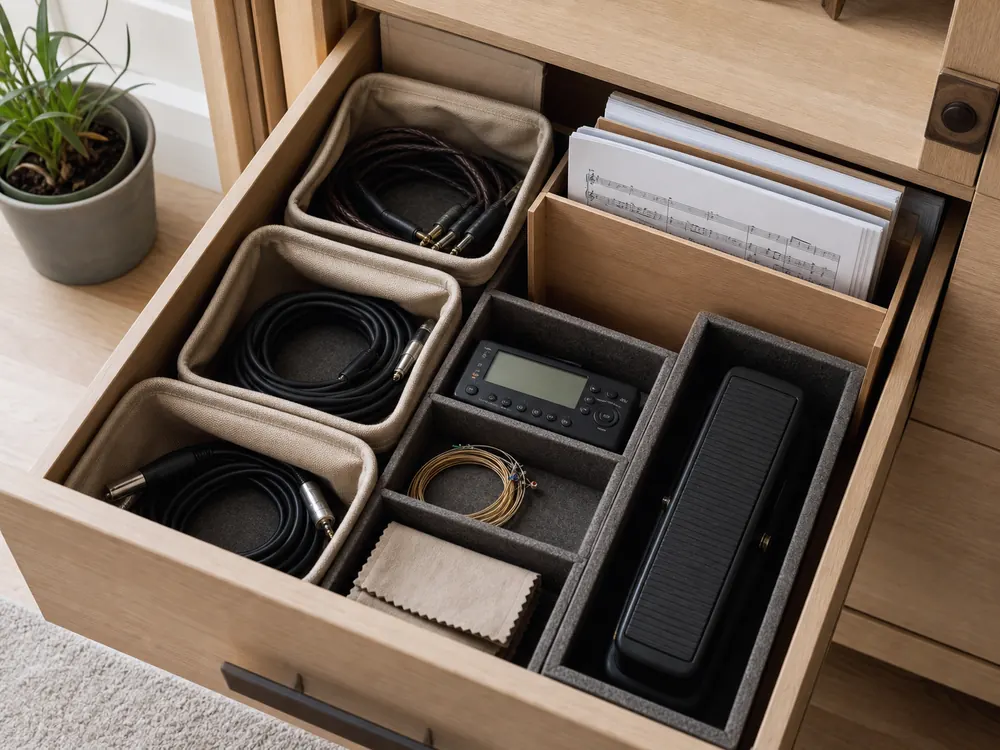
Use gentle over-under coils where appropriate, secure them loosely, and keep each cable in a breathable or padded pouch. Separate power, audio, microphone, and instrument leads so the correct setup can be reached without untying the entire drawer.
Inspect plugs and jackets before storage. Small apartment musical instrument storage ideas should retire damaged cables from active gear immediately rather than hiding them beneath a neat coil.
Store Strings, Reeds, And Small Parts Deliberately
Spare strings, reeds, mouthpieces, rosin, tuners, picks, and cleaning cloths need divided, dry storage matched to their material. Keep replacement parts in original packaging when it provides useful identification and protection. Do not let batteries leak inside tuners or pedals during long storage.
Follow device guidance, separate depleted cells for appropriate recycling, and keep small parts away from children and pets. The strongest small apartment musical instrument storage ideas protect both the instrument and the shared walking route.
Keep Sheet Music Upright And Supported
Use a firm vertical file for active scores and a separate archive for seldom-used music. Broad dividers prevent thin books from slumping, while a shallow tray can hold loose pages during one practice cycle.
Avoid storing paper directly against damp walls or beneath cleaning liquids. Digitized reference copies may reduce handling, but preserve lawful originals and backups according to their real value and condition.
Build A Five-Minute Practice Launch
Place the case, chair, stand, accessory drawer, and sheet music along one short route. The setup should not require moving a coffee table, unloading a closet, or stretching a cable across the apartment's main walkway.
Return cleaning cloths, loosen or secure components only as the instrument requires, close the case, and clear the stand after practice. The strongest small apartment musical instrument storage ideas make playing easier while restoring the shared room completely.
Before Buying Organizers For Musical Instrument
Product research for musical instrument should begin after the shelf and route are measured. Use “Map Heat, Sun, Moisture, And Traffic First” as the non-negotiable requirement and treat every additional compartment as optional.
Treat these small apartment musical instrument storage ideas product searches as comparison notes; verify current claims, sizes, and maker requirements for the exact item being considered.
- Padded instrument case floor rack
- Keyboard dust cover
- Padded audio cable pouches
- Sheet music storage file
Research Behind Musical Instrument
Sources for musical instrument cover its safety and material care. The related Her Neat Nest guides connect this musical instrument plan with nearby apartment zones.
- Smithsonian care of musical instruments
- Small Apartment Hobby Storage Ideas
- Cord Organization Ideas For Small Apartments
- Small Apartment Book Storage Ideas
Musical Instrument: Practical Questions
Should musical instruments be stored in their cases?
Fitted protective cases are often the safest apartment option, but follow the instrument maker's care guidance and use stable support away from heat, moisture, direct sun, and traffic.
Can I hang a guitar in a rental apartment?
Only with appropriate permission, verified structural mounting, a hanger designed for the instrument, and acceptance of the increased dust, light, and collision exposure.
How should a keyboard be stored in a small apartment?
Keep it horizontal on a rated shelf, stand, or case with full chassis support, a dust cover, and pedals and adapters in a nearby padded compartment.
Use “Map Heat, Sun, Moisture, And Traffic First” to set up the musical instrument system; let “Build A Five-Minute Practice Launch” judge the return. Every musical instrument group should finish its task without borrowing a chair or a neighboring shelf. When the collection or route changes, revisit musical instrument and correct the smallest failing boundary before adding another container.