
A paint collection can look orderly by color and still be difficult to use safely. Water-based tubes mix with unfamiliar mediums, brush tips dry against the bottom of a jar, a leaking bottle reaches paper, and one active palette expands across the dining table long after the session ends.
Paint storage should make medium, cleanup method, and product risk visible before color. Keeping wet tools, dry paper, labeled products, and finished work on separate routes protects both the apartment and the artwork. That is the standard these small apartment art paint supplies storage ideas need to meet in a lived-in room.
Read original labels and current maker guidance for every paint, medium, cleaner, aerosol, solvent, pigment, and disposal method. Some art products may present inhalation, ingestion, skin, fire, reactivity, or environmental concerns. Keep products secured from children and pets, do not decant into food containers, and use qualified local hazardous-waste guidance when a product is unknown or unsuitable for ordinary disposal.
Measure the tallest bottle, longest tube, brush length, palette, paper size, removable spill tray, cabinet opening, and active carry tray. Include the hand clearance needed to read labels and lift products upright without dragging neighboring containers forward.
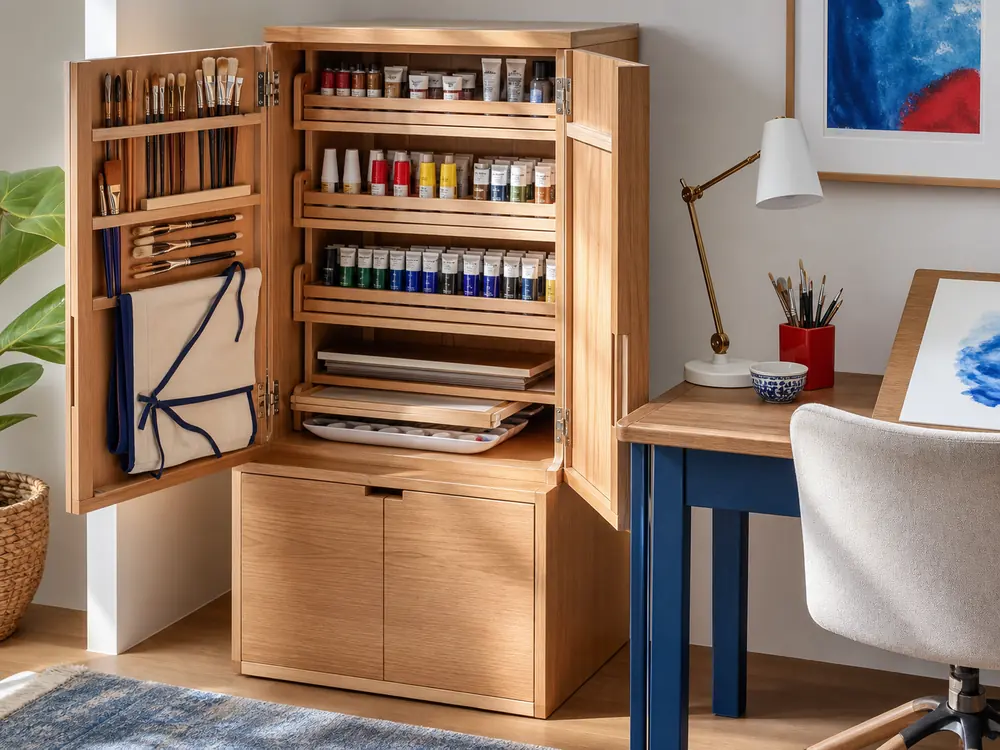
Small Apartment Art Paint Supplies Storage Ideas Begin By Medium
Separate watercolor, gouache, acrylic, oil, ink, additives, cleaners, and unknown products before arranging colors. Medium and label information drive compatibility, use, cleaning, ventilation, and disposal more reliably than a rainbow display. Keep every original label visible and isolate any leaking, swollen, corroded, unlabeled, or unfamiliar container for appropriate assessment.
Use “Small Apartment Art Paint Supplies Storage Ideas Begin By Medium” as a decision point, not a label. Ask what changes after a week of ordinary use and whether “Keep Tubes And Jars Visible” can still happen without borrowing another surface. That question gives art paint supplies a practical hierarchy and exposes containers that add steps without protecting anything.
Keep Tubes And Jars Visible
Place compatible tubes and jars upright or in a maker-suitable supported position inside removable shallow trays. Visibility exposes duplicates, dried product, damaged caps, and realistic remaining volume without opening every container. Wipe exterior residue appropriately, close each product fully, and avoid pressure that forces paint toward a weak cap or seam.
Before finalizing “Keep Tubes And Jars Visible,” rehearse the least convenient version of the routine: low light, limited time, or a partially occupied work surface. Then check whether “Use Secondary Containment” still has a safe route. For art paint supplies, resilience in that ordinary moment is more valuable than a perfectly full shelf.
Use Secondary Containment
Give each compatible product group a washable or suitable removable tray that fits fully within the stable cabinet shelf. Containment can limit a small leak and simplify inspection, but it does not make incompatible or hazardous materials safe to store together.
Check tray material, cracks, residue, shelf load, and product directions before returning the group. A limited active palette keeps small apartment art paint supplies storage ideas useful on a shared table.
The apartment tradeoff behind “Use Secondary Containment” appears when it competes with “Store Brushes Clean And Dry.” Give priority to the condition that is hardest to reverse, then let convenience decide between the remaining options. For art paint supplies, that usually means preventing damage or lost context before trying to save a few more inches.
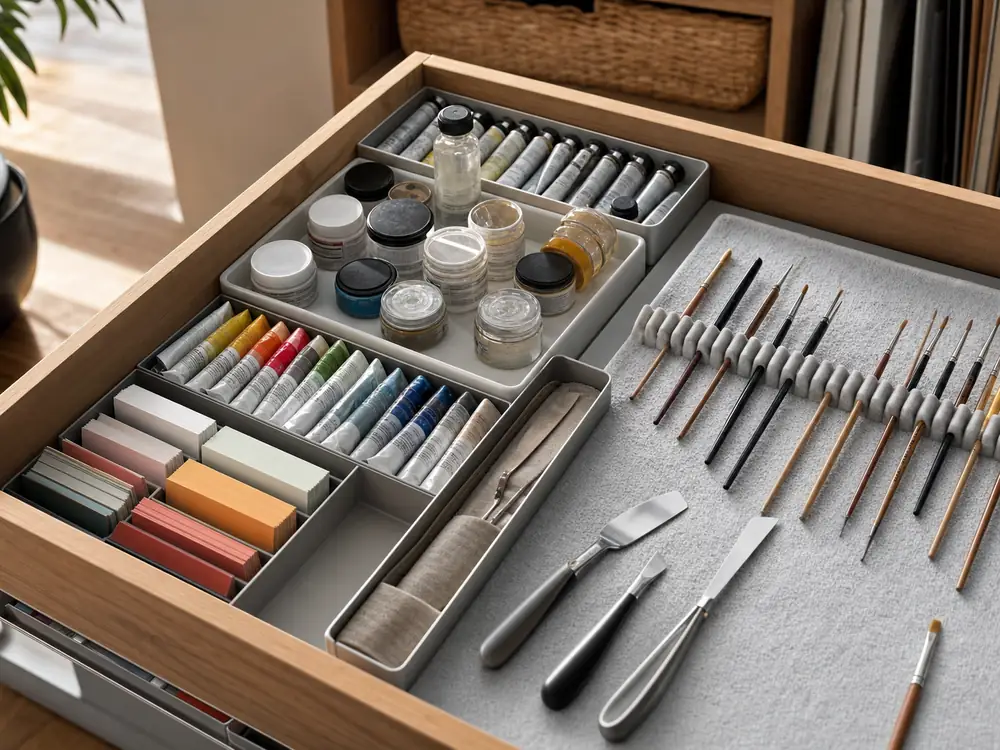
Store Brushes Clean And Dry
Clean brushes using the correct method for their paint system, dry them fully with bristles protected, and store them without crushing tips. A decorative cup can bend long handles, collect dust, and leave damp bristles pressed in a damaging direction. Inspect ferrules, handles, shedding, residue, and shape, keeping wet cleaning tools away from clean paper and closed cabinets.
Think of “Store Brushes Clean And Dry” and “Separate Palettes And Mixing Tools” as consecutive art paint supplies actions rather than separate bins. The art paint supplies shelf should support their handoff without a temporary chair, floor, or countertop. For art paint supplies, that continuity keeps unfinished work or uncertain condition from disappearing between sessions.
Separate Palettes And Mixing Tools
Clean suitable palettes and tools, let them dry, and store them flat or upright with full support away from fresh paper. Dried residue and sharp palette knives can transfer color, scratch surfaces, or make a clean project tray harder to understand. Sheath appropriate tools, follow product-specific cleanup guidance, and never scrape unknown residue into an unsuitable drain or bin.
The maintenance cost of “Separate Palettes And Mixing Tools” matters as much as its footprint. Count how many lids, lifts, and relocations stand between use and “Protect Paper And Finished Studies.” If the path is longer than the actual task, simplify the container or narrow the active set of art paint supplies.
Protect Paper And Finished Studies
Keep unused paper, swatches, sketchbooks, and dry finished studies in a clean supported file outside the paint-containment zone. Paper readily records leaks, humidity, pressure, and dirty fingers, so proximity should not mean direct contact with products. Verify that a study is fully dry and stable before filing, and seek conservation advice for valuable or deteriorating work.
The strongest evidence for “Protect Paper And Finished Studies” is a clean return with one hand occupied and the room in normal use. Keep “Build One Limited Active Palette” in place during the test. A system for art paint supplies that works only after clearing the room has solved a styling problem, not a storage problem.
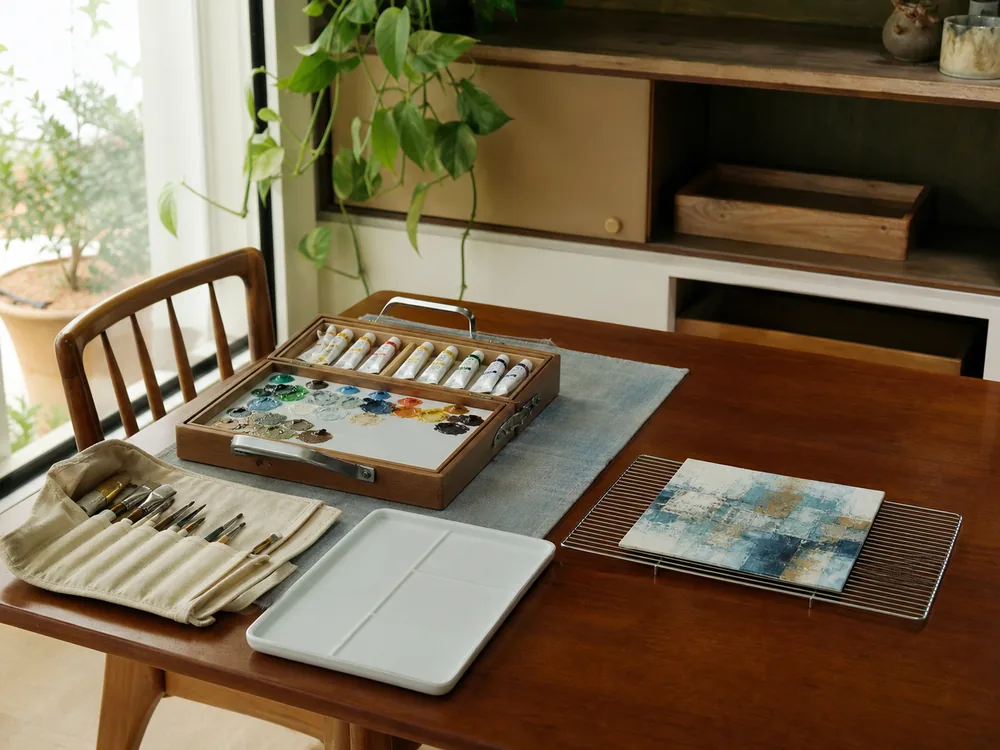
Build One Limited Active Palette
Select the paints, brushes, palette, and support needed for one current project and place them in a handled tray sized to the receiving shelf. A limited active set reduces setup time without moving the whole collection or leaving every color on a shared table.
Return substitute colors immediately, keep labels visible, and stop adding products when the tray can no longer lift level. Quarterly review makes small apartment art paint supplies storage ideas responsive to product condition and local disposal guidance.
The visual calm promised by “Build One Limited Active Palette” comes from fewer unresolved decisions, not hidden contents. Name anything awaiting repair, cleaning, disposal, or research before moving on to “Create A Drying Boundary.” That makes the art paint supplies cabinet honest about what is ready and what still requires attention.
Create A Drying Boundary
Assign one stable ventilated location for appropriate wet work and cleaned tools where they cannot be touched, stacked, or returned too early. Drying is a temporary project state, not permission to leave art materials across seats, floors, or food surfaces. Follow the material's curing and ventilation guidance, protect the household, and move only fully stable pieces into storage.
Audit Labels And Disposal Quarterly
Review product identity, condition, dates, duplicates, local disposal options, cabinet cleanliness, and household access every quarter. Regular review prevents forgotten leftovers and unidentified jars from becoming the permanent foundation of the paint cabinet. Use current local hazardous-waste guidance where applicable and document what left so the same unnecessary product is not replaced automatically.
Before Buying Organizers For Art Paint Supplies
The shopping question for art paint supplies is whether a product solves “Small Apartment Art Paint Supplies Storage Ideas Begin By Medium” without undermining “Audit Labels And Disposal Quarterly.” Check the loaded version, not only the empty catalog photograph.
Compare the linked small apartment art paint supplies storage ideas categories for specifications rather than ratings alone, then verify every current claim with the manufacturer.
- Art paint storage cabinet
- Paint tube organizer
- Artist brush storage roll
- Paint spill containment tray
Reference Notes For Small Apartment Art Paint Supplies Storage Ideas
Sources for art paint cover its safety and material care. The related Her Neat Nest guides connect this art paint plan with nearby apartment zones.
- U.S. EPA guidance for household hazardous waste
- Small Apartment Craft Storage Ideas
- Small Apartment Art Portfolio Storage Ideas
- Small Apartment Hobby Storage Ideas
Small Apartment Art Paint Supplies Storage Ideas: Practical Questions
How should art paints be stored in a small apartment?
Keep original labels visible, separate products by medium and compatibility, use suitable secondary containment, secure household access, and follow maker and local hazardous-waste guidance.
Can paint brushes be stored upright?
Only when clean and fully dry with bristles protected from pressure; the best position depends on brush construction and maker care guidance.
What should I do with old or unknown art paint?
Do not pour it into drains or ordinary containers; identify it if safely possible and use current local environmental or hazardous-waste guidance for disposal.
Use “Small Apartment Art Paint Supplies Storage Ideas Begin By Medium” to set up the art paint system; let “Audit Labels And Disposal Quarterly” judge the return. Every art paint group should finish its task without borrowing a chair or a neighboring shelf. When the collection or route changes, revisit art paint supplies and correct the smallest failing boundary before adding another container.