
An aquarium may occupy one measured footprint, but its care equipment quickly spreads beyond the glass. Food packets collect beside the lamp, a damp net leans against the wall, test tubes migrate toward the kitchen, and the siphon becomes an awkward coil that never seems fully dry.
Aquarium storage should follow the water-change route. Dry food and electrical spares need distance from wet tools, while treatments must remain labeled and close enough to use without balancing bottles on the tank rim. Seen this way, small apartment aquarium supplies storage ideas are about continuity and condition, not maximum capacity.
Useful small apartment aquarium supplies storage ideas divide the category by contamination risk and frequency. Dry food and records need clean closed storage; wet tools need washable trays and airflow; water treatments need upright containment; electrical spares need a dry location away from leaks and splashes.
The fish species, tank system, product manufacturer, veterinarian, and water professional should control care decisions. Storage cannot substitute for correct dosing, cycling, filtration, electrical safety, or animal-health guidance. It can make the correct routine easier to follow and easier to audit.
Measure the cabinet only after mapping a complete maintenance session. Include the bucket, hose length, towel landing point, nearest suitable water source, electrical cords, and the path used to carry water. A cabinet that looks tidy but blocks maintenance will not stay organized.
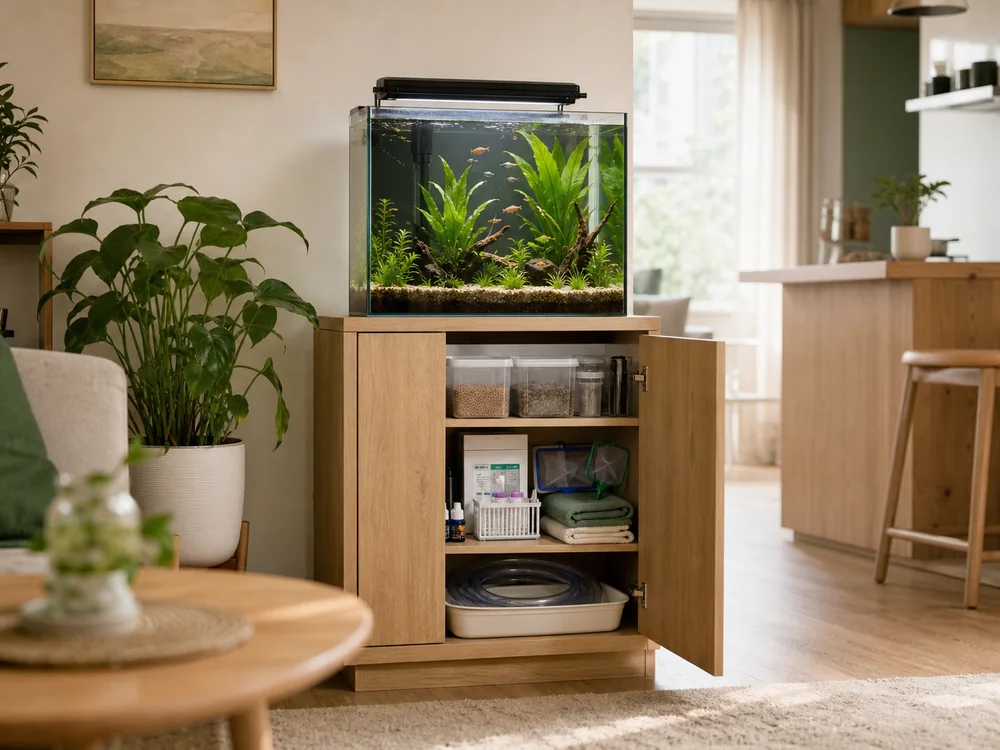
Inventory Supplies By Dry, Wet, Chemical, And Electrical
List every food, test, treatment, net, scraper, siphon, bucket, towel, spare part, and electrical accessory. Note package dimensions, expiration dates, leakage risk, and how often each item is used so incompatible categories do not share one open bin. Remove expired or unidentified products according to local guidance and manufacturer information.
Never pour aquarium chemicals into household containers or combine leftovers. Keep original packaging and dosing information intact so a neat shelf does not create dangerous ambiguity.
The apartment tradeoff behind “Inventory Supplies By Dry, Wet, Chemical, And Electrical” appears when it competes with “Small Apartment Aquarium Supplies Storage Ideas Start Beside The Tank.” Give priority to the condition that is hardest to reverse, then let convenience decide between the remaining options. For aquarium supplies, that usually means preventing damage or lost context before trying to save a few more inches.
Small Apartment Aquarium Supplies Storage Ideas Start Beside The Tank
Choose a stable cabinet or shelf close enough to shorten the maintenance route but outside splash zones and electrical ventilation. Confirm the furniture can carry its intended load without affecting the aquarium stand, which must support the tank independently and correctly.
Leave door and drawer clearance for a bucket or tray to move without striking the tank. Keep the home's main route open during ordinary days and maintenance, especially where children, pets, or mobility needs make a loose hose a serious trip hazard.
Think of “Small Apartment Aquarium Supplies Storage Ideas Start Beside The Tank” and “Keep Food Sealed, Dry, And Easy To Rotate” as consecutive aquarium supplies actions rather than separate bins. The aquarium supplies shelf should support their handoff without a temporary chair, floor, or countertop. For aquarium supplies, that continuity keeps unfinished work or uncertain condition from disappearing between sessions.
Keep Food Sealed, Dry, And Easy To Rotate
Store fish food in its original closed package inside a clean secondary bin when useful. Mark opening dates in a private care record, use the oldest suitable food first, and avoid keeping large backstock that can age before it is used. Food should not share a tray with wet nets, tank-water tools, cleaning cloths, or leaking treatments.
Wash hands before and after feeding or handling aquarium equipment, following current public-health and species-care guidance. A washable tray gives small apartment aquarium supplies storage ideas a reliable place for damp equipment to dry.
The maintenance cost of “Keep Food Sealed, Dry, And Easy To Rotate” matters as much as its footprint. Count how many lids, lifts, and relocations stand between use and “Give Test Kits An Upright Protected Module.” If the path is longer than the actual task, simplify the container or narrow the active set of aquarium supplies.
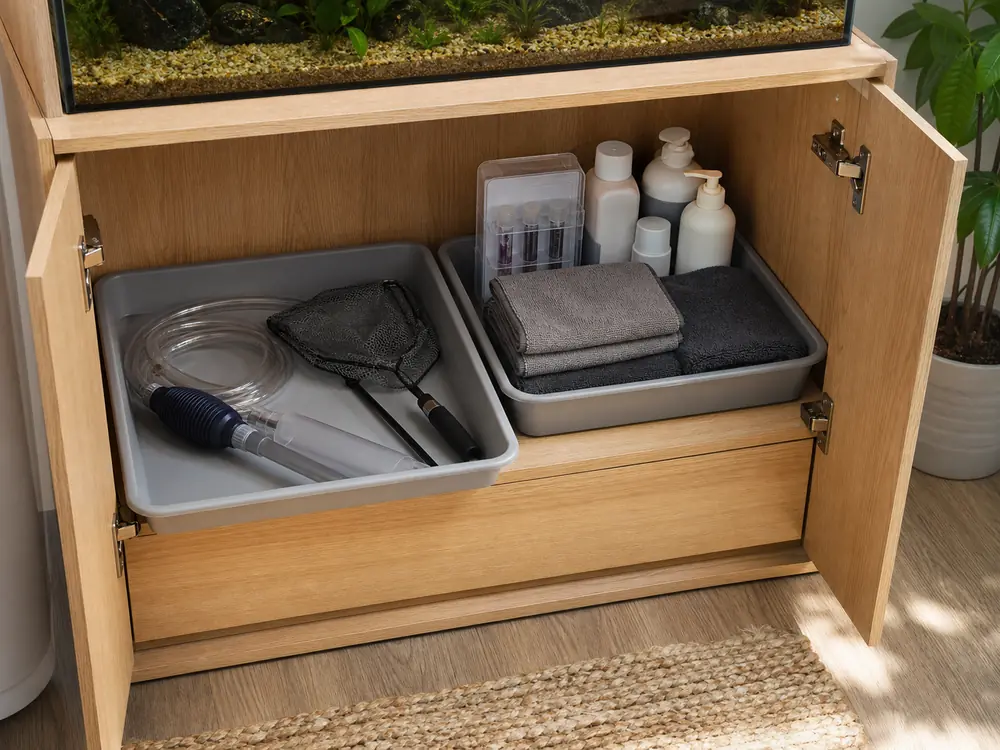
Give Test Kits An Upright Protected Module
Keep test bottles and tubes upright in a shallow lipped container that can be removed as one unit. Protect glass components from impact, close caps completely, and retain current color cards and product information with the exact kit they belong to.
Store the module away from food preparation, direct sun, heat, and unauthorized access. Review dates and bottle condition on a recurring schedule; a faded card, cracked tube, or leaking reagent should not disappear behind a decorative basket.
Use A Washable Tray For Nets And Siphons
Coil a clean siphon loosely in a tray large enough to support the hose without sharp bends. Nets, algae tools, and dedicated brushes need their own contact points so damp surfaces can dry before the cabinet closes.
Drain and clean equipment according to appropriate care guidance, then inspect for cracks, residue, odor, and trapped water. Do not place aquarium tools in the kitchen sink or food-preparation area when safer cleaning arrangements are available.
Reserve Towels And A Floor Barrier For Aquarium Work
Keep a small set of clearly dedicated absorbent towels near the tank, separate from bath and kitchen linens. A washable waterproof mat or tray can define the bucket zone and catch ordinary drips before they reach wood floors or rugs.
Dry towels fully before enclosed storage and launder them separately when appropriate. Check the floor, baseboard, cabinet back, and wall after each water change because persistent dampness needs correction rather than a larger towel pile.
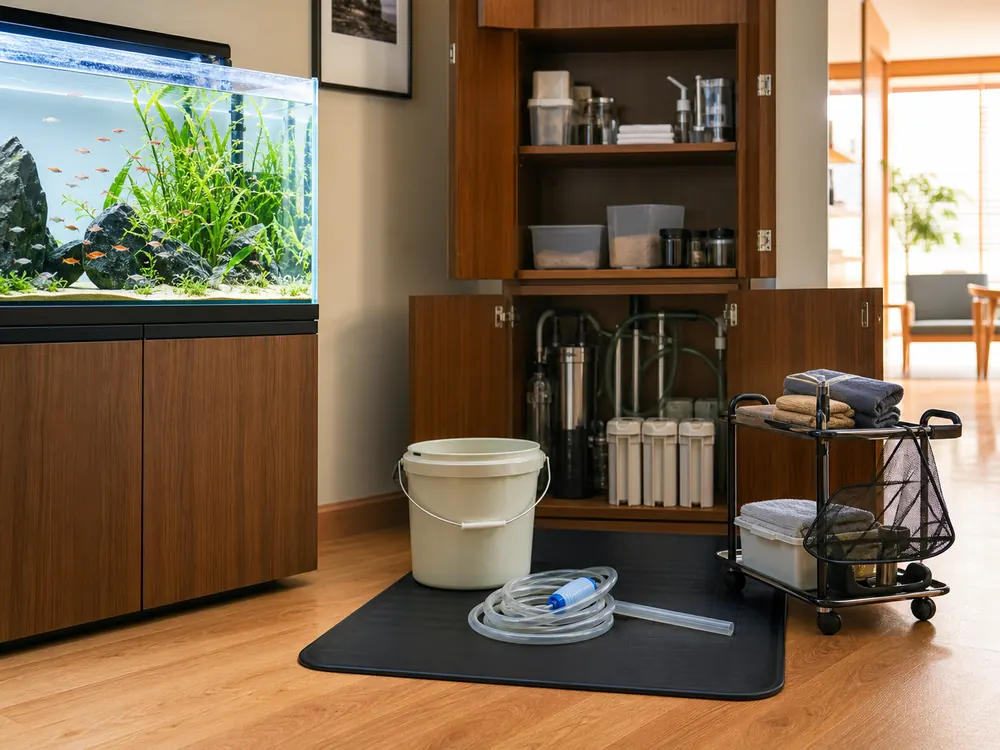
Separate Electrical Spares From Water Tools
Store dry spare cables, timers, air pumps, and manufacturer-approved parts above or apart from wet maintenance supplies. Keep cords uncrushed, plugs clean, and ventilation openings unobstructed; never place a power strip inside a damp cabinet or beneath a leak path. Use drip loops and electrical arrangements recommended for the aquarium equipment and dwelling.
Damaged cords, hot plugs, moisture near outlets, or repeatedly tripped protection require immediate attention from an appropriate qualified professional. The maintenance route is the real test of small apartment aquarium supplies storage ideas.
Contain Water Treatments Without Hiding Their Identity
Place treatment bottles upright in a lipped bin, keeping caps, labels, dosage tools, and safety information intact. Separate products that should not contact each other and keep them inaccessible to children and pets.
Record purchase and opening dates without writing over critical product information. If a bottle leaks, swells, crystallizes, loses its label, or changes unexpectedly, isolate it and follow manufacturer and local disposal guidance instead of guessing at reuse.
Build A Water Change Route Before Storage
Stage the bucket, mat, hose, towels, and tools in the order they are used. Protect the aquarium heater and filter according to their manufacturer guidance, control the hose at both ends, and keep carried water loads manageable.
Small apartment aquarium supplies storage ideas work when every item returns after the floor is dry and the equipment is inspected. A short checklist in the care record can prevent a valve, towel, or unplugged device from being overlooked.
Review The Cabinet With Every Tank Change
New fish, plants, filters, medicines, or testing routines can change the supply footprint. Re-measure before adding containers and remove obsolete parts that no longer match the current system rather than building a museum of old aquarium equipment.
Inspect monthly for leaks, pests, food dust, corroded metal, brittle tubing, expired products, and cabinet swelling. Early evidence protects both the household and the aquarium better than a closed door that is never opened between maintenance days.
Before Buying Organizers For Aquarium Supplies
Before buying storage for aquarium supplies, use the dimensions and failure points in “Inventory Supplies By Dry, Wet, Chemical, And Electrical” and “Review The Cabinet With Every Tank Change” as the comparison brief. A aquarium supplies product is useful only if it protects that route after the cabinet is loaded.
For small apartment aquarium supplies storage ideas, use these category links only to compare current formats and dimensions; confirm the listing and maker guidance against this apartment's measured route.
- Aquarium maintenance tool tray
- Aquarium test kit organizer
- Aquarium siphon hose holder
- Sealed fish food container
Evidence Supporting Small Apartment Aquarium Supplies Storage Ideas
Sources for aquarium cover its safety and material care. The related Her Neat Nest guides connect this aquarium plan with nearby apartment zones.
- CDC guidance for staying healthy around fish and aquariums
- Small Apartment Pet Supplies Organization
- Small Apartment Cleaning Supplies Storage Ideas
- Small Apartment Bathroom Towel Storage Ideas
Aquarium Supplies: Practical Questions
Where should aquarium supplies be stored in a small apartment?
Use a stable closed cabinet near the tank but outside splash and leak paths, with separate modules for dry food, treatments, wet tools, towels, and electrical spares.
Can fish food and aquarium tools share one cabinet?
They can share furniture only when dry food is sealed and physically separated from wet tools, tank-water equipment, treatments, and dedicated cleaning towels.
How should an aquarium siphon be stored?
Clean and drain it appropriately, inspect it, coil it loosely without kinks, and let it dry in a washable tray away from food and electrical parts.
Use “Inventory Supplies By Dry, Wet, Chemical, And Electrical” to set up the aquarium system; let “Review The Cabinet With Every Tank Change” judge the return. Every aquarium group should finish its task without borrowing a chair or a neighboring shelf. When the collection or route changes, revisit aquarium supplies and correct the smallest failing boundary before adding another container.